By
By 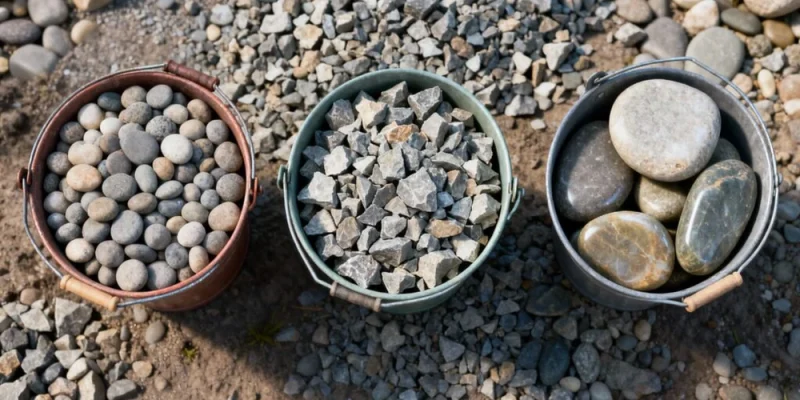
Most people blame the stone when a driveway ruts or a path turns into a mud pit. I’ve done it myself. Twenty tons spread on a Saturday, and by spring the wheel tracks had sunk four inches and the edges looked like a toddler poured a cereal bowl onto the lawn. The stone was fine. My order was wrong.
Here’s the thing that trips almost everyone up: gravel and crushed stone are not the same material, and treating them as interchangeable is the single most common mistake in a yard project. Gravel comes out of riverbeds and shorelines with smooth, rounded edges. Crushed stone is rock run through a crusher and screened into specific sizes, so every piece has angular faces that lock together underfoot. That interlock is the whole reason a proper driveway holds up while a rounded gravel one keeps shifting. Quarries also screen out the fine dust and chips on some products and leave it in on others, which is the second half of the decision you’re about to make.
If you’d rather skip the trial and error, know that when you buy crushed stone for landscaping from a supplier who sorts it by size and keeps the grades consistent, half the battle is already won. The other half is knowing which grade belongs where. That’s what this covers.
Quick answer on which stone goes where
If you only read one part of this, read the table. Every stone yard uses slightly different local names, but the underlying grades are the same across the country.
| Grade | Typical size | Where it belongs |
|---|---|---|
| 3/4 inch clean | About 3/4 inch, no fines | Drainage beds, French drains, behind retaining walls |
| 3/4 inch modified | About 3/4 inch plus stone dust | Driveway base, patio base, anything that must compact hard |
| Half inch clean | About 1/2 inch, no fines | Garden paths, walkways, dry creek beds |
| Grit screening | Fine chips and dust | Top dressing, filling between pavers, finishing a path |
That “clean” versus “modified” label is doing more work than any other word on the tag. Clean stone has the dust washed out, so water passes straight through it and nothing binds. Modified stone keeps the dust, and once you wet it and run a plate compactor over it, the whole layer sets up like a poor man’s concrete. Buy clean stone for a driveway base and it will never lock. Buy modified stone for a French drain and you’ve built a plug. I’ve watched both mistakes happen in the same weekend, on the same street.
Why the same gray rock has different names everywhere
Ask three neighbors what crushed stone is and you’ll get three answers, usually with real confidence behind them. The confusion has roots. Aggregate is one of the oldest building materials there is, and the US Geological Survey has documented stone quarrying in this country going back to the 1600s, when workers split granite and limestone by hand for foundations and roads. Local terminology grew up around those regional quarries, which is why one county calls it item four, another calls it 2A, and a third just calls it driveway stone. The rock didn’t change. The paperwork did.
That matters when you place an order. Read the spec sheet, not the nickname. Size in inches and the clean or modified designation are the only two fields you actually need.
Do you need a border, or can you get away without one?
Short answer: if the stone touches grass, put in an edge. Loose angular stone spreads. Not dramatically, but a couple of inches a season, and after three winters your two foot path looks like it gave up. A steel or aluminum edging strip buried flush keeps the line sharp and takes an afternoon with a rubber mallet.
Where it gets interesting is weather. Freeze and thaw cycles work loose material from below, and heavy rain scatters it from above. According to the National Severe Storms Laboratory, flash flooding is one of the most common weather hazards in the United States, and a driveway apron is one of the first places homeowners notice it.
Water needs somewhere to go. Slope your base away from the house at about a two percent grade and let the stone do the rest. If the yard pools water after a storm, that’s your signal to dig a drainage bed of clean stone instead of adding another layer of modified.
The quantity math nobody wants to do
Here’s the formula, and it’s the same one I use every time. Length in feet times width in feet times depth in feet, then divide by 27. That gives you cubic yards. Multiply by about 1.4 to get tons for standard crushed stone.
A 12 foot by 30 foot driveway at a 4 inch base:
- 12 x 30 = 360 square feet.
- 360 x 0.33 feet of depth = about 119 cubic feet.
- 119 divided by 27 = 4.4 cubic yards.
- 4.4 x 1.4 = roughly 6 tons for that first layer.
Order a little over. A half ton of cushion costs less than a second delivery fee, and running short on a Saturday afternoon means either a return trip or a thin spot you’ll be looking at for five years. For anything over about eight cubic yards, take the bulk delivery instead of bagged product. You’ll move it with a wheelbarrow either way, but the bagged route means forty trips to the store and a lot more money per ton.
Site prep steps I’d do in this order
Strip the sod and get down to bare soil. Four inches is the target for a walkway, six for a driveway that sees a truck. Lay woven landscape fabric over the soil if weeds are a chronic problem, not plastic, which traps water and turns the base to soup. Spread the modified stone in two lifts rather than one and compact each lift separately. Then top with the clean or decorative layer, raked level, and leave the final grade about an inch below your lawn so a mower doesn’t catch the edge.
For the rainy stretches in spring and fall, having extra material on site before the weather turns saves you two weeks of staring at a half finished project. Loose stone and wet weather don’t mix well on the schedule. The work wants dry ground, and dry ground shows up when it feels like it.
Before you place the order
Walk your property with the size chart in mind and decide the grade for each spot first. Paths want half inch clean, driveway bases want modified, and anything touching water wants clean stone with no dust. Then measure, run the math, round up, and confirm the delivery truck can get to the drop spot. Or set the pallets or pile on the driveway and wheelbarrow it from there, which isn’t glamorous but works fine.
What’s the one spot in your yard you’ve been avoiding because you’re not sure what to put down? Start there. Ordering the right grade the first time turns a weekend of regret into a project you don’t think about again for a decade.